Green Earth Sciences Building, 104
367 Panama Street, Stanford, CA 94305
View map
This event is over.
Event Details:
Abstract
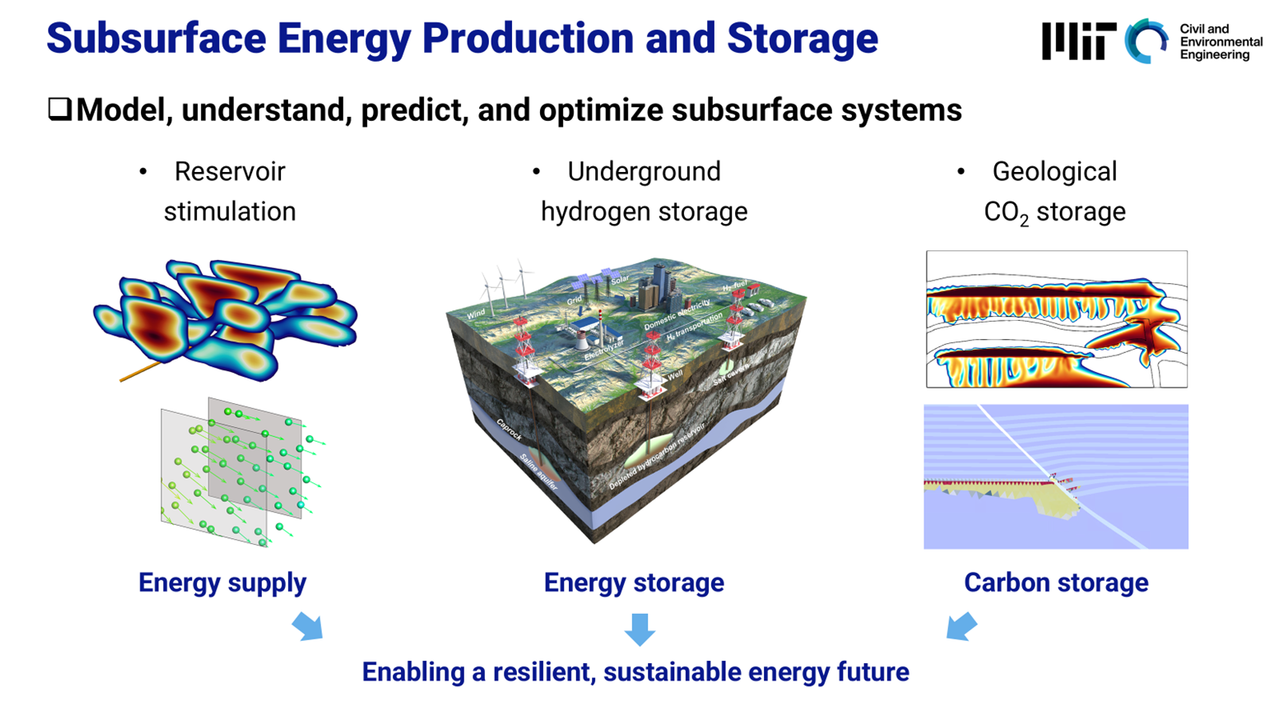
Subsurface energy production and storage play a central role in the energy transition. However, subsurface systems are inherently complex. Predicting and optimizing these systems remains challenging due to coupled multiphysics processes, multiscale behavior, and substantial uncertainty. In this talk, I will present three lines of research spanning reservoir stimulation, underground hydrogen storage (UHS), and geological CO2 storage (GCS). For reservoir stimulation, I will introduce a physics-based hydraulic fracturing model that simulates Lagrangian proppant transport in propagating three-dimensional fractures at the field scale, and show how it can inform proppant design for applications such as enhanced geothermal systems. For UHS, I will demonstrate how reservoir simulation provides mechanistic insight into salt precipitation during hydrogen cycling, and how deep-learning surrogates can accelerate prediction to support storage design and operational decisions. For GCS, I will present an end-to-end workflow for stochastic modeling of CO2 migration across and along faults, quantifying and reducing uncertainty in fault behavior relevant to secure sequestration. Together, these topics illustrate how advances in numerical modeling and machine learning can enable more effective subsurface energy production and storage toward a resilient and sustainable energy future.
Bio
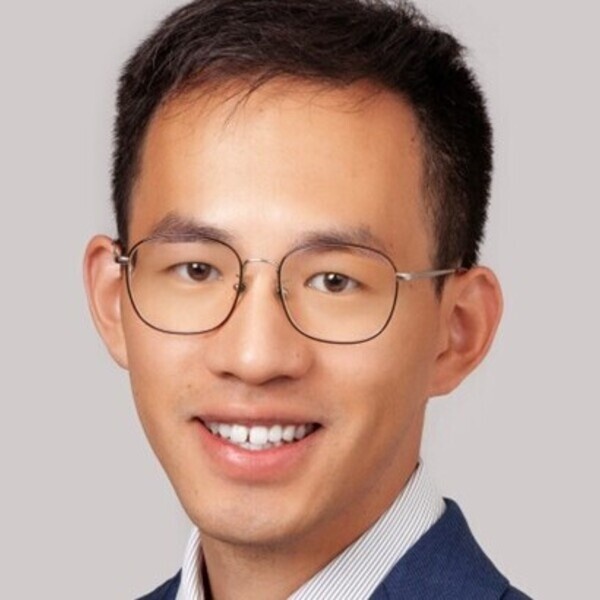
Dr. Shaowen Mao is a Postdoctoral Associate in the Department of Civil and Environmental Engineering at MIT and the MIT Earth Resources Laboratory (ERL), working in the Juanes Research Group.
Prior to joining MIT, he served as a Senior Computational Scientist at ResFrac Corporation and as a Staff Scientist in the Earth and Environmental Sciences Division at Los Alamos National Laboratory (LANL). He earned his Ph.D. in Petroleum Engineering from Texas A&M University, where he received the Faculty Award of Excellence, and was previously a University of California/Los Alamos Entrepreneurial Postdoctoral Fellow at LANL.
His research focuses on subsurface energy and environmental systems, with interests spanning underground hydrogen storage, geothermal energy, carbon sequestration, hydrocarbon development, and geologic hydrogen. Dr. Mao specializes in developing and applying advanced computational techniques, including multi-physics simulations and machine learning, to tackle complex problems involving coupled thermo-hydro-mechanical-chemical processes in various subsurface systems. His work contributes to advancing sustainable energy solutions and understanding subsurface processes critical to energy and environmental challenges.
Research/Related Papers
Mao, S., Mehana, M., Yu, S., Kang, Q., Moridis, G., Guiltinan, E., Frash, L., K.C., B., & Gross, M. R. (2026). Effects of aquifer salinity on underground hydrogen storage. Energy Conversion and Management, 347, 120450. https://doi.org/10.1016/j.enconman.2025.120450.
Mao, S., Yu, S., Xu, J., Chen, H., Zhao, W., Blunt, M. J., Kang, Q., Gross, M., Chen, B., Van Wijk, J., Yuan, Q., Gao, K., Kazi, S. R., & Mehana, M. (2025). Geologic hydrogen: a review of resource potential, subsurface dynamics, exploration, production, transportation, and research opportunities. Energy & Environmental Science, 18, 9991–10035. https://doi.org/10.1039/D5EE02910D.
Mao, S., Carbonero, A., & Mehana, M. (2025). Deep learning for subsurface flow: A comparative study of U‐Net, Fourier neural operators, and transformers in underground hydrogen storage. Journal of Geophysical Research: Machine Learning and Computation, 2(1), e2024JH000401. https://doi.org/10.1029/2024JH000401.
Mao, S., Mehana, M., Huang, T., Moridis, G., Miller, T., Guiltinan, E., & Gross, M. R. (2024). Strategies for hydrogen storage in a depleted sandstone reservoir from the San Joaquin Basin, California (USA) based on high-fidelity numerical simulations. Journal of Energy Storage, 94, 112508. https://doi.org/10.1016/j.est.2024.112508.
Mao, S., Chen, B., Malki, M., Chen, F., Morales, M., Ma, Z., & Mehana, M. (2024). Efficient prediction of hydrogen storage performance in depleted gas reservoirs using machine learning. Applied Energy, 361, 122914. https://doi.org/10.1016/j.apenergy.2024.122914.
Mao, S., Chen, B., Morales, M., Malki, M., & Mehana, M. (2024). Cushion gas effects on hydrogen storage in porous rocks: Insights from reservoir simulation and deep learning. International Journal of Hydrogen Energy, 68, 1033–1047. https://doi.org/10.1016/j.ijhydene.2024.04.288.
Mao, S., Wu, K., & Moridis, G. (2023). Integrated simulation of three-dimensional hydraulic fracture propagation and Lagrangian proppant transport in multilayered reservoirs. Computer Methods in Applied Mechanics and Engineering, 410, 116037. https://doi.org/10.1016/j.cma.2023.116037.